
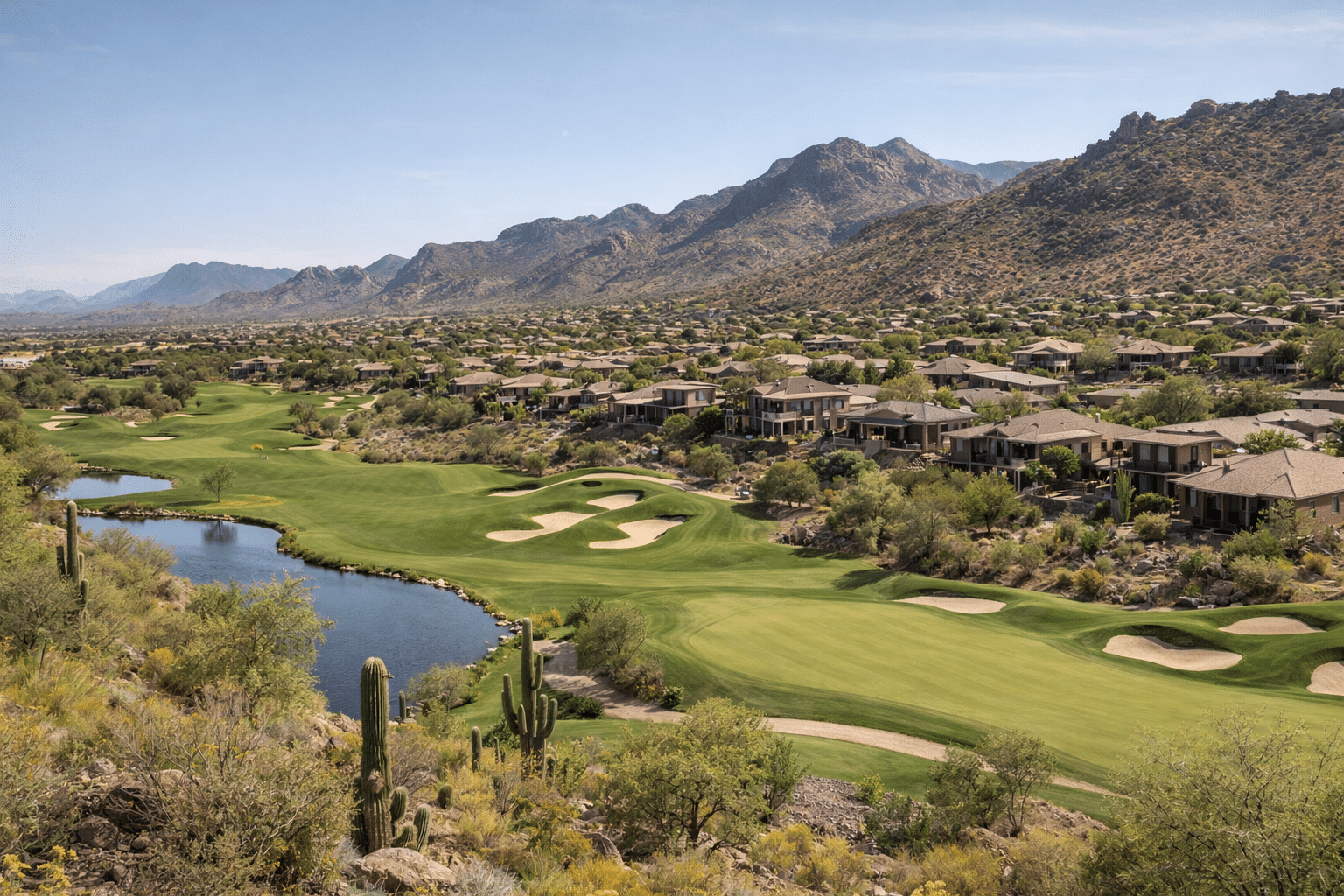
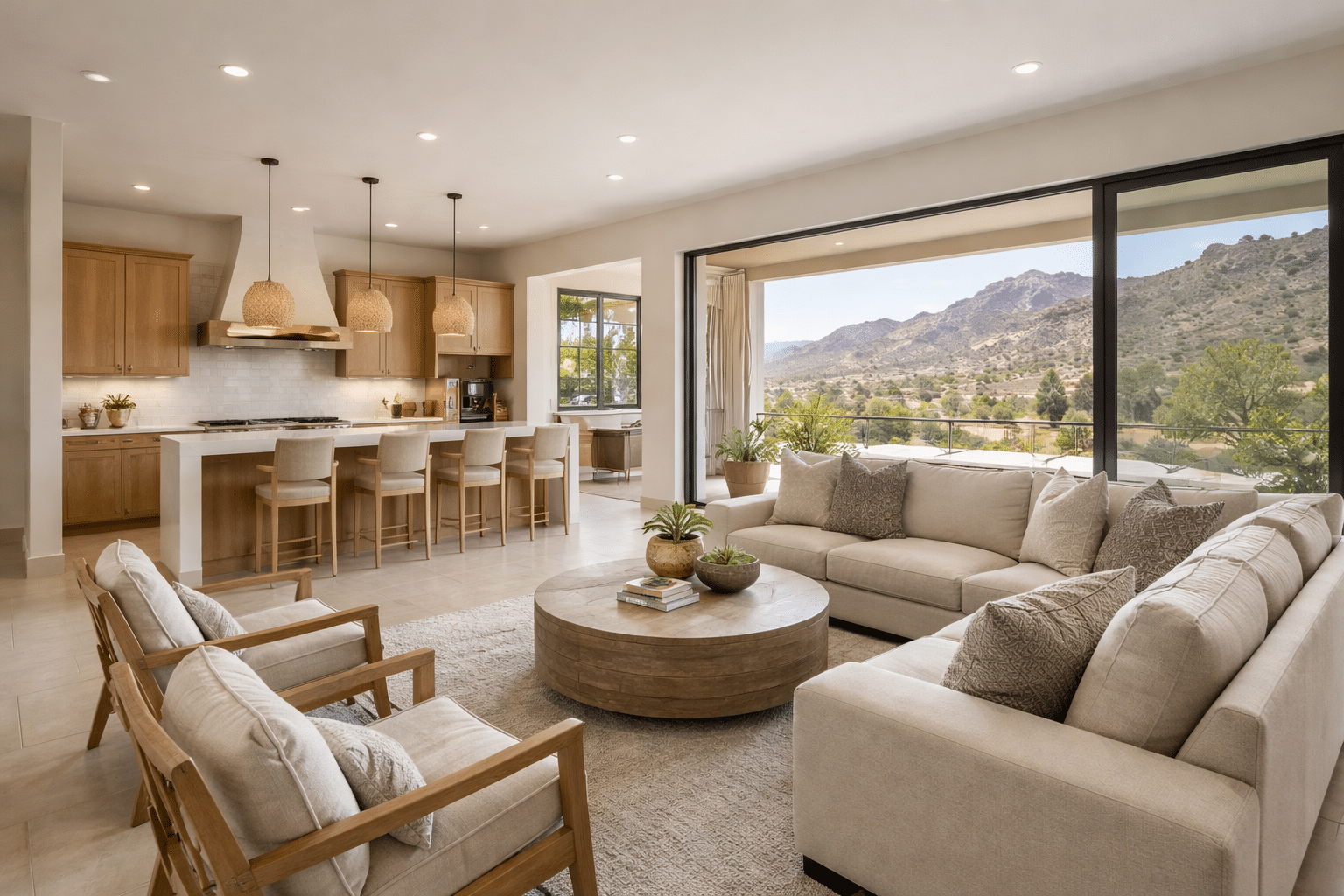
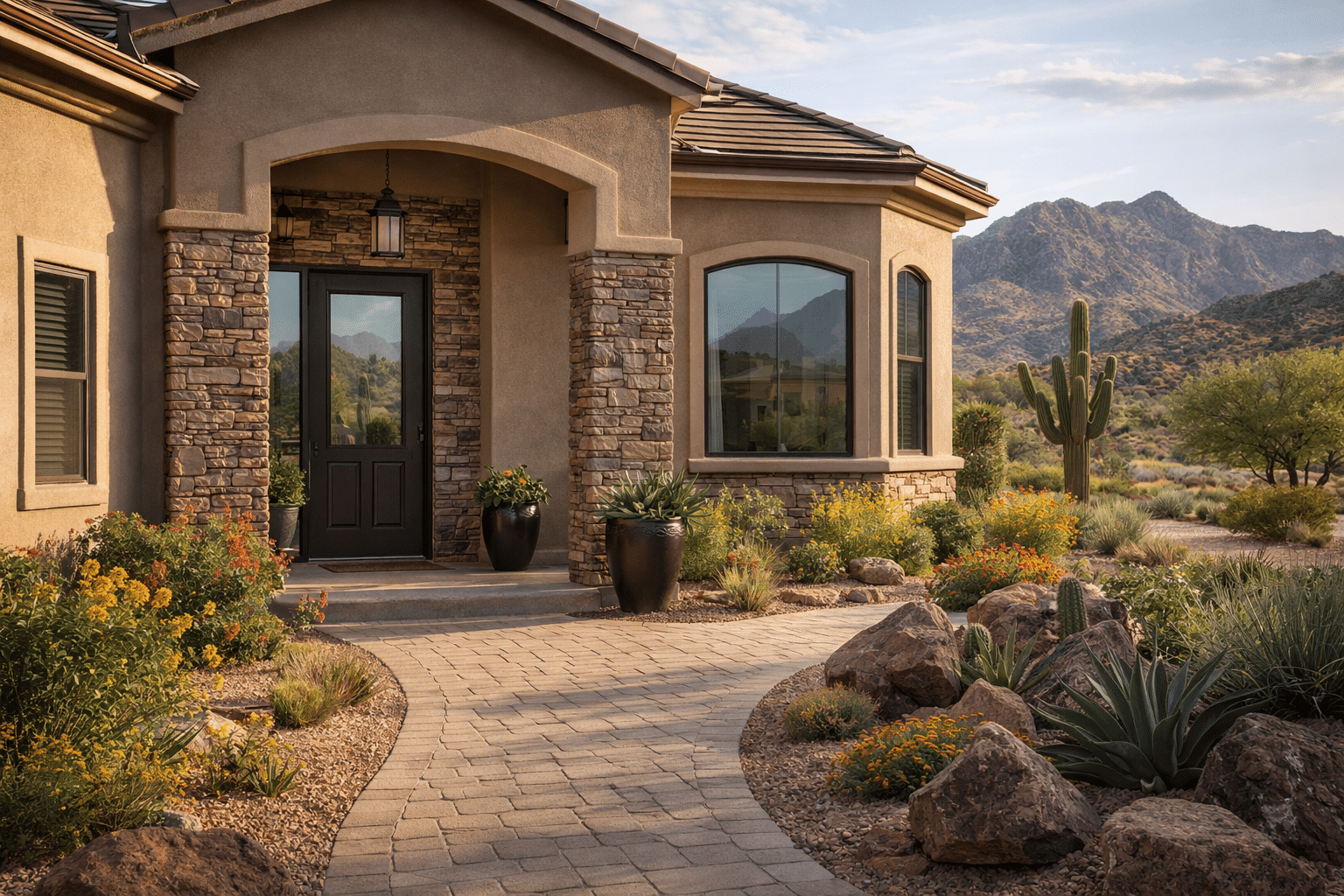
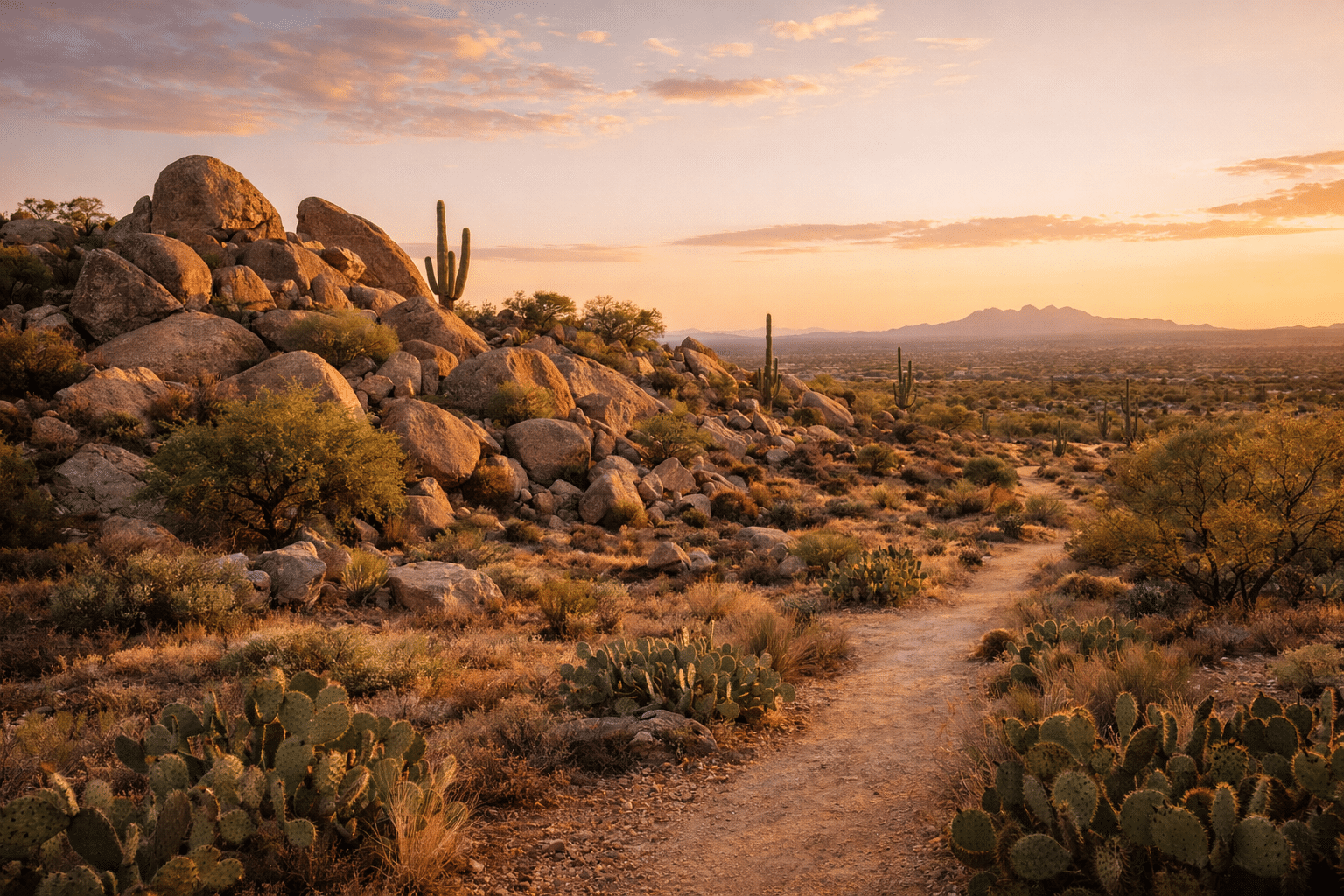
Fountain Hills real estate holds a distinct position in the Phoenix metro. This planned community — built around one of the world’s tallest decorative fountains — borders Fountain Hills, Arizona to the east where the Fort McDowell Yavapai Nation reservation land begins, and sits at the base of McDowell Mountain Regional Park on the north and west. Fountain Hills homes for sale attract buyers who prioritize open desert scenery, a slower daily pace, and access to trail systems that larger cities cannot match. The town’s main corridors — Shea Boulevard and Palisades Boulevard — place residents within reach of Scottsdale’s employment centers and retail. The Arizonan Team at West USA Realty works with buyers and sellers across the full Fountain Hills market, from entry-level condos to guard-gated golf course estates.
Fountain Hills is a smaller market by volume than Scottsdale or Gilbert, and that scale works in certain buyers’ favor. The inventory turns at its own pace. Buyers rarely face the same competition pressure they encounter in high-volume Phoenix suburbs, but well-priced homes in desirable communities still attract multiple offers. Price ranges across Fountain Hills real estate listings run broadly — entry-level attached homes in the low-to-mid $300s, single-family homes between the mid-$400s and the upper $600s, and golf course or custom properties that push well into seven figures in guard-gated neighborhoods.
The market divides roughly into three tiers. The lower tier covers condominiums, townhomes, and older single-family homes near the town center, where prices are more accessible and walkability to the Avenue of the Fountains is a genuine draw. The middle tier covers established neighborhoods with standard single-family homes, HOA amenities, and lot sizes that give homeowners real outdoor space. The upper tier is dominated by guard-gated communities — FireRock Country Club, Adero Canyon, and Eagle Mountain — where buyers pay for security, golf access, mountain views, and custom construction standards.
Days on market in Fountain Hills typically run longer than in the fastest-moving Phoenix zip codes. That rhythm gives buyers a slightly longer window to evaluate a property without scrambling. It also means sellers need to price accurately from day one — overpriced listings accumulate visible history in a small community where every active listing is known. Pricing to comparable sales within the same community carries more weight here than in high-turnover suburban markets.
Fountain Hills property values have appreciated at roughly double the rate of many Phoenix suburbs over the past decade, and the structural reason is straightforward: constrained supply. Protected land on three sides — McDowell Mountain Regional Park to the north and west, Fort McDowell Yavapai Nation reservation land to the east — means the town cannot expand the way that Buckeye, Queen Creek, or Peoria can. What gets built is what exists. That dynamic supports long-term appreciation in a way that high-volume growth corridors cannot replicate once supply catches up with demand.
For buyers considering Fountain Hills as an investment property, the buyer pool is distinctive. The town draws high-income seasonal residents, remote workers, and retirees at a much higher concentration than the broader Phoenix metro. That audience is relatively insensitive to short-term mortgage rate movement and tends to hold properties longer, which keeps turnover lower and supports price stability across market cycles. According to the Cromford Market Index, Fountain Hills has ranked among the top two seller’s markets in the Phoenix Valley — behind only Paradise Valley — a position that reflects genuine underlying demand rather than speculative activity. Communities with views, golf course frontage, or direct trail access — Sunridge Canyon, Eagle Mountain, and FireRock Country Club among them — have historically held value most consistently within that investment case.
Maricopa County, Arizona encompasses Fountain Hills and administers property tax assessment for all residential properties in the area. Effective tax rates in Maricopa County tend to run lower than in many comparable metro markets — a detail worth factoring into total housing cost comparisons. Buyers should confirm current assessed values and effective rates on specific properties through the Maricopa County Assessor’s online portal, as valuations adjust on an annual cycle.
The Scottsdale housing market borders Fountain Hills along the northwest corridor, and buyers frequently evaluate both towns simultaneously. Scottsdale offers larger inventory, faster freeway access to central Phoenix employment centers, and more commercial development. Fountain Hills offers a smaller-town environment, preserved desert surroundings, and direct access to trail systems connected to McDowell Mountain Regional Park. The comparison typically resolves around lifestyle priorities rather than price alone.
City of Scottsdale official resources documents municipal services and development activity in the neighboring market — useful context for buyers making a side-by-side evaluation of both areas.
ARMLS covers all transaction data in Fountain Hills. Working with an agent who monitors list-price-to-sale-price ratios, pulls comparable sales by community, and understands seasonal rhythm in this specific market gives buyers a clear, data-grounded picture of where pricing stands.
Geography sets Fountain Hills apart from most Phoenix suburbs, and it shapes what its neighborhoods look like. The town covers roughly 13 square miles of buildable land, surrounded on multiple sides by protected desert and reservation land that caps expansion. Most of the residential inventory sits in distinct planned communities — each with its own HOA structure, architectural standards, and amenity profile. Knowing which community matches your priorities before scheduling tours narrows the search to homes that will actually fit.
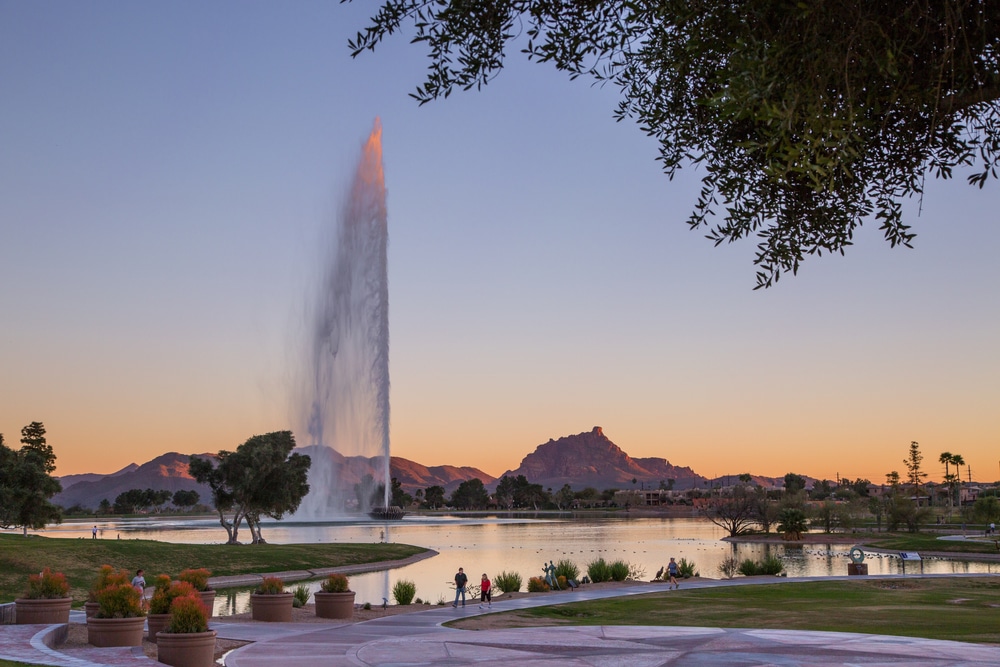
The area surrounding the downtown fountain and the Avenue of the Fountains carries the most mixed product type — older single-family homes, condominiums, and townhomes — along with the highest walkability to restaurants, shops, and community events. The fountain itself shoots 560 feet into the air during scheduled activations, and it is visible from most parts of the town center. Buyers who prioritize neighborhood feel and daily walkability over square footage consistently look here first.
Adero Canyon represents the newer wave of development in Fountain Hills — a gated community on the northeast edge of town with contemporary home designs, mountain views, and direct trail access to McDowell Mountain Regional Park. The Adero Canyon real estate guide covers current listings and the specifics of how gated access and HOA governance operate within the community.
FireRock Country Club is the benchmark guard-gated golf community in town. Properties include custom homes, semi-custom estates, and golf course lots with direct views of the 18-hole course. HOA fees in FireRock cover gate operations, landscaping in common areas, and general community maintenance. The community draws buyers who want both the social character of a country club setting and the security of a gated perimeter. FireRock Country Club homes for sale covers current inventory and community-specific details.
Eagle Mountain is a well-established golf course community on the north side of town, situated along ridgelines with panoramic views toward the Verde River corridor. Homes here tend to sit on larger lots. The golf course is public-access, which draws buyers who want the setting of a golf community without mandatory membership requirements.
Eagles Nest and Sunridge Canyon are established gated communities offering more traditional product — custom and semi-custom homes, with single-level floor plans prominent in Eagles Nest. Desert Canyon adds golf course frontage and elevated lot positions to the options in this price range.
Most Fountain Hills communities operate under HOA governance, and fee structures vary significantly. Buyers should request HOA financial documents — including the reserve fund study and CC&Rs — before making an offer. Understanding reserve fund health, any active special assessments, and rental restrictions early in the process avoids surprises during due diligence.
Fountain Hills real estate listings in the upper and mid-range price tiers concentrate in these named communities. Demand is strongest in neighborhoods with views, trail access, or golf course frontage.
For buyers evaluating the mid-range tier of Fountain Hills real estate listings, three communities consistently come up in the same conversation. Eagles Nest is a guard-gated community where single-level floor plans make up a meaningful share of the resale inventory — a detail that matters to buyers who specifically want one-story living without sacrificing the gated environment. Sunridge Canyon offers a similar gated profile with a canyon-influenced setting that gives many lots natural separation and elevated view corridors. Desert Canyon adds golf course frontage to the equation, with lot positions along the course giving buyers a combination of open space and community structure that the non-gated resale market cannot replicate.
All three communities carry HOA governance, and fee structures vary — buyers should compare reserve fund health and CC&R restrictions across each before narrowing focus. The West USA Realty Buyers Hub covers the full due diligence process for HOA purchases in Arizona.
Single-family homes make up the largest share of Fountain Hills properties for sale, and the range within that category is wide. Smaller homes from the early 1990s on standard lots near the town center sit at one end. Custom estates of 4,000-plus square feet on golf course or mountain-view lots at the other. Most mid-range single-family product was built between the late 1980s and the mid-2000s. Many of these homes have been updated with new kitchens, baths, and exterior finishes consistent with current buyer expectations, which means buyers are not necessarily stepping into a dated product even in older neighborhoods.
Condominiums and townhomes account for a smaller share of the Fountain Hills market compared to larger metro areas. Options exist primarily near the downtown core, in developments that run roughly 900 to 1,800 square feet. These properties appeal to buyers seeking a lower entry price point, minimal exterior maintenance, and proximity to the Avenue of the Fountains. The inventory in this category is limited — buyers targeting condos and townhomes specifically should expect fewer active listings at any given time than in comparable Scottsdale markets.
New construction in Fountain Hills is limited by geography. The town’s buildable land is constrained by McDowell Mountain Regional Park, reservation land, and existing development. When new phases come to market — as with Adero Canyon — they price at the upper end of the Fountain Hills range. Buyers who assume new construction is readily available here should ask directly what is active before building expectations around it.
Custom home lots are occasionally available within existing gated communities. These lots allow buyers to build to personal specifications within the community’s architectural guidelines. FireRock Country Club and Adero Canyon have historically carried custom lot inventory, though availability is unpredictable. Lot buyers should confirm CC&R requirements and construction timelines before purchase.
Age-qualified communities are present in Fountain Hills. Specific developments operate under 55-plus active adult standards, and buyers seeking or specifically avoiding this designation should confirm community status before scheduling tours. An agent familiar with the Fountain Hills inventory will know which communities carry age restrictions without requiring the buyer to research each one separately.
The deepest inventory in any given search window will come from the resale single-family homes market in established non-gated neighborhoods. That is where buyers have the widest selection, the most pricing data to work from, and the most room to negotiate based on days on market and list-price-to-sale-price history.
Fountain Hills houses for sale cover a range that is narrow in total volume but genuinely diverse in character — from a sub-$400k condo walking distance from the fountain to a $2M-plus custom estate in FireRock. Knowing where your priorities sit before you search determines which slice of that range is actually relevant to you.
The Fountain Hills Unified School District serves students from kindergarten through 12th grade within the town’s boundaries. The district includes Fountain Hills Elementary School, Fountain Hills Middle School, and Fountain Hills High School — all located within a compact geographic footprint. The small size of the district means that most students who live in Fountain Hills attend the same campus feeder pattern throughout their K-12 schooling, which creates a consistent school-community connection that buyers with children often view favorably. Enrollment boundaries and any open enrollment options should be confirmed directly with the district, as these can change between academic years.
Private school options within Fountain Hills include Four Peaks Christian Academy and Fountain Hills Christian Academy. Families who want a broader selection of private or charter schools will find additional campuses in Scottsdale and the northeast Phoenix corridor within reasonable driving distance. The Fountain Hills Unified School District does not offer a charter school track within the town itself, so families with specific school-type preferences should research options in the surrounding market before committing to a purchase.
Daily life in Fountain Hills feels different from a standard Phoenix suburb, and buyers who tour the town consistently notice it. The Avenue of the Fountains serves as the main street — a walkable boulevard with restaurants, galleries, boutiques, and coffee shops. Community events, outdoor concerts, and a weekly farmers market draw residents to the avenue on a regular basis. The fountain activates on a scheduled cycle and is visible from most parts of the town center — it is one of those local details that remains genuinely notable rather than background scenery.
Trail access from within residential neighborhoods is one of the town’s practical distinctions. The trail system connected to McDowell Mountain Regional Park is accessible without a car from multiple points in the northern sections of Fountain Hills. Hiking, mountain biking, and trail running are daily activities for a significant share of residents, not weekend events requiring a drive to the trailhead.
Commute times from Fountain Hills to central Scottsdale run approximately 20 to 30 minutes under normal traffic conditions via Shea Boulevard and the Palisades corridor. The town does not have direct freeway access, which is the primary commute consideration for buyers who need to reach downtown Phoenix or the I-10 and Loop 101 interchange regularly. Commuters heading west typically route through Scottsdale or take the Beeline Highway north to the Pima connector.
The Town of Fountain Hills official website documents parks, community programs, public services, and the permit process for home improvements — a useful starting point for both new residents and buyers planning post-close renovation work.
Buying in Fountain Hills follows the standard Arizona residential purchase process, but a few local factors are worth accounting for from the start. The town’s small inventory, active golf course community market, and HOA-heavy landscape make preparation more important here than in larger, higher-volume suburban markets. The following steps reflect how the process typically unfolds for buyers working in Fountain Hills.
Get your mortgage pre-approval in hand before touring. The Fountain Hills market is smaller than suburban Phoenix, and well-priced homes in gated communities move without extended negotiation windows. A formal pre-approval from a lender who has reviewed your complete financial profile positions you to submit an offer the day you find the right property. A pre-qualification letter is not sufficient in a competitive situation.
Define your community criteria before you start scheduling tours. Gated versus non-gated, golf course access, age-qualified restrictions, HOA fee tolerance, and view orientation all determine which neighborhoods are actually relevant to your search. Sorting this out before touring keeps the process focused and avoids the common pattern of expanding search criteria after every home visit.
Work with a buyer’s agent who tracks this specific market. Fountain Hills has its own pricing norms and transaction patterns. An agent who pulls regular comparable sales analyses in FireRock, Eagle Mountain, and the non-gated mid-range tier will give you pricing guidance that is grounded in this community — not extrapolated from the broader Scottsdale market.
Request HOA documents before making an offer. Arizona law requires sellers to provide HOA documents, but reviewing the reserve fund study, any active or pending special assessments, and the CC&Rs before going under contract — rather than after — eliminates the risk of discovering a financial problem during the inspection period. HOA financial health varies significantly across Fountain Hills communities.
Use the Arizona Residential Purchase Contract. Arizona uses a standard contract developed by the Arizona Association of Realtors. Your agent will walk you through earnest money deposit requirements, the inspection period timeline, and the closing costs structure specific to Maricopa County residential transactions.
Select a title company with local transaction history. Arizona is a title insurance state, and established title companies with experience in Fountain Hills transactions can streamline HOA document processing, CC&R compliance review, and closing coordination.
Closing costs in Maricopa County typically range from 2% to 5% of the purchase price, depending on loan type, lender fees, and the specific title and escrow services selected. Buyers should request a loan estimate from their lender early in the process to understand the full cost picture before making an offer.
The Town of Fountain Hills permits and development services page is the starting point for any post-purchase renovation work that requires a building permit — a practical resource to bookmark at closing.
Retiring in Fountain Hills appeals to a specific kind of buyer — one who wants a genuine small-town character, daily access to outdoor recreation, and proximity to world-class healthcare without living inside a large urban grid. The combination of McDowell Mountain Regional Park trail access, a walkable downtown along the Avenue of the Fountains, multiple golf course communities, and mild winters draws both full-time retirees and snowbirds who maintain a Fountain Hills property as a seasonal base.
Active adult and age-qualified communities do exist within Fountain Hills, offering 55-plus buyers the option of an age-restricted environment with dedicated amenities and simplified exterior maintenance. Buyers who prefer a non-age-restricted neighborhood but still want single-level floor plans will find the strongest selection of that product in Eagles Nest, where one-story homes represent a meaningful share of the resale inventory.
The lock-and-leave profile of many Fountain Hills communities — particularly those with HOA-managed landscaping and gated perimeters — suits seasonal buyers who want the security of a maintained property between visits. The Mayo Clinic campus in nearby Scottsdale is the most significant healthcare anchor for buyers factoring medical access into a retirement location decision.
Buyers who want a larger-scale dedicated 55-plus master-planned community should also evaluate PebbleCreek in Goodyear or Leisure World in Mesa — both offer the active adult amenity depth that Fountain Hills, as a smaller town, does not replicate at scale.
Relocating to Fountain Hills from Chicago, Seattle, or Los Angeles puts buyers in a position most local buyers never experience — everything about the market feels smaller, slower, and more deliberate, and that adjustment is usually a feature rather than a problem. Fountain Hills draws a disproportionately large share of remote workers and second home buyers precisely because the lifestyle the town offers — trail access from within residential neighborhoods, a walkable downtown on the Avenue of the Fountains, and the preserved Sonoran Desert character that surrounds it — is difficult to find at this price point anywhere else in the Phoenix metro.
Out-of-state buyers should account for a few practical realities before committing to a search. Fountain Hills has no direct freeway access — Shea Boulevard and the Palisades corridor are the primary routes into Scottsdale and the broader metro. For buyers who work remotely full-time, that is a non-issue. For buyers with regular obligations in central Phoenix or the I-10 corridor, commute time should be modeled honestly before narrowing focus here. Buyers who want a similar desert lifestyle with slightly faster freeway access should also evaluate Cave Creek to the northwest or the Rio Verde corridor to the north, both of which serve comparable lifestyle priorities with different access profiles.
Fountain Hills AZ real estate does not include significant new builder inventory — the town’s geography constrains development. Out-of-state buyers expecting a new-construction product should review what is currently active in the Arizona new construction market before building search expectations around it in this specific town.
Fountain Hills property values have held stronger than most Phoenix suburbs over the past several years, and sellers who enter the market with accurate pricing and a well-prepared home consistently see favorable outcomes. According to the Cromford Market Index, Fountain Hills ranks among the top two seller’s markets for single-family homes in the Phoenix Valley — a position that reflects genuine, sustained demand rather than a short-term spike. That standing matters when you are deciding whether now is the right time to list your Fountain Hills home.
Days on market in Fountain Hills run longer than in the fastest-moving Phoenix corridors, which means sellers need to approach pricing with discipline from the start. Overpriced listings accumulate visible history in a small market where buyers and agents track every active property. A well-priced home in a desirable community — particularly those with mountain views, golf course frontage, or gated access — still attracts strong offers and favorable list-price-to-sale-price ratios. Homes that sit are almost always a pricing problem, not a demand problem.
Sellers in FireRock Country Club and Adero Canyon should pull comparable sales specifically within their community — not from the broader Fountain Hills market — because pricing norms inside gated communities diverge significantly from non-gated resale neighborhoods. Working with an agent who monitors ARMLS data for your specific subdivision gives you a pricing strategy grounded in what buyers have actually paid, not what sellers have asked.
Explore the West USA Realty Sellers Hub for guidance on the full listing and closing process in Arizona.
Prices across Fountain Hills span from the low-to-mid $300s for condominiums and entry-level attached homes up to multi-million-dollar custom estates in guard-gated communities. Most single-family resale homes in established non-gated neighborhoods fall between the mid-$400s and the upper $600s. Gated golf communities like FireRock Country Club and Adero Canyon push above that range, with custom properties reaching well into seven figures depending on lot position, views, and finishes.
Most communities in Fountain Hills operate under HOA governance, and fees vary considerably by community type. Non-gated neighborhood HOAs may run $50 to $150 per month covering basic common area maintenance. Guard-gated communities with golf course access or resort-level amenities can run $300 to $600 or more per month. Buyers should request the HOA financials — including the reserve fund study — before making an offer, not during the inspection period.
New construction in Fountain Hills is limited by the town’s geography. Protected land on three sides and reservation land to the east restrict how much developable area remains within the town boundaries. When new development phases come to market, they price at the upper end of the Fountain Hills range. Buyers should ask their agent directly about any active phases before building expectations around new construction availability.
Fountain Hills is served by the Fountain Hills Unified School District, which includes elementary, middle, and high school campuses located within the town. Private school options are also available within Fountain Hills, and additional charter and private options exist in the nearby Scottsdale corridor. Buyers with school-age children should verify current attendance boundaries with the district before closing.
Fountain Hills falls within Maricopa County, and property taxes are assessed and collected by the Maricopa County Assessor and Treasurer. Taxes are based on the assessed full cash value of the property and are typically billed in two installments per year. Effective tax rates in Maricopa County tend to run lower than in many comparable metro-area markets, though buyers should confirm current rates on specific properties through the county assessor’s portal before closing.
Fountain Hills sits directly east of Scottsdale, connected primarily by Shea Boulevard and the Palisades corridor. Commute times to central Scottsdale run approximately 20 to 30 minutes depending on time of day and destination. The town does not have direct freeway access, so buyers who need to reach downtown Phoenix or the I-10 / Loop 101 interchange regularly should factor in the additional drive time through Scottsdale.
Demand concentrates in a handful of named communities. FireRock Country Club and Adero Canyon draw buyers who want guard-gated access and premium views. Eagle Mountain properties in Fountain Hills attract buyers who want a golf community setting with public course access and no mandatory membership requirement. Eagles Nest and Sunridge Canyon appeal to buyers seeking established gated neighborhoods at a lower HOA cost than the top-tier communities. For buyers who prioritize walkability over seclusion, the neighborhoods near the Avenue of the Fountains remain consistently active.
Geography shapes the distinction most clearly. Fountain Hills is a planned community with defined boundaries and constrained expansion capacity — it will not become a full-scale urban grid. Scottsdale is a major city with broad commercial corridors, large employment centers, and a wide range of property types at every price point. Cave Creek sits to the northwest and carries a rural, horse-property character with larger lots and minimal HOA presence. Fountain Hills fits buyers who want a self-contained small town with genuine trail access, a walkable downtown, and close proximity to Scottsdale amenities without living inside a large urban market.

Premier builders have established a strong presence in Fountain Hills' luxury home market. Local custom builders bring decades of experience crafting unique desert estates that complement the natural landscape perfectly. Home prices in Fountain Hills range from the mid $400,000s for modest properties to multi-million dollar estates. The current market shows strong appreciation, with median home prices increasing approximately 8% annually over the past five years. Single-family homes dominate the market, offering diverse options from cozy patio homes to expansive desert estates. Luxury condominiums and townhomes provide alternative lifestyle options for those seeking low-maintenance living with premium amenities. The average time on market currently stands at 62–67 days, reflecting strong demand and limited inventory. The price per square foot averages $357–$404, varying significantly based on location, views, and property amenities. Current market trends indicate continued growth potential, supported by the area's limited developable land and high desirability.

The Fountain Hills Unified School District serves the community with exceptional educational opportunities for students of all ages. McDowell Mountain Elementary School has earned an "A" rating from the Arizona Department of Education for its excellence. Fountain Hills Middle School and High School offer comprehensive academic programs alongside strong athletic and arts opportunities. The district maintains small class sizes and employs highly qualified teachers who frequently earn state and national recognition. Several private schools in the area provide alternative educational options, including Fountain Hills Christian School and Desert Vista. Local educational resources include the Fountain Hills Library's extensive youth programs and various tutoring centers throughout town.

The renowned Fountain Hills Golf Club offers challenging play across eighteen holes with spectacular mountain and desert vistas. The SunRidge Canyon Golf Club provides another premier golfing experience with its unique desert canyon setting and world-class facilities. Fountain Park, spanning 64 acres, serves as the community's crown jewel with walking paths and the iconic fountain. The Community Center features state-of-the-art fitness equipment, multiple swimming pools, and various recreational programs for all ages. Tennis enthusiasts enjoy access to multiple courts throughout the community, including night-lit facilities for evening play. The Desert Vista Park offers additional recreational opportunities with baseball diamonds, soccer fields, and basketball courts.

The Fountain Hills Plaza serves as the primary shopping destination, featuring boutique stores and essential retail services. The Avenue of the Fountains showcases local artisans, unique shops, and various dining establishments within walking distance of downtown. Local restaurants range from casual cafes to upscale dining venues, offering diverse culinary experiences for every taste. The Fountain Hills Theater presents year-round productions, while the Community Center hosts various cultural events and activities. The weekly Farmers Market brings fresh local produce and artisanal products to the community every Thursday. The nearby Mayo Clinic and numerous medical facilities ensure residents have access to world-class healthcare services.

Major highways including the Loop 101 and State Route 87 provide convenient access to greater Phoenix destinations. The average commute to downtown Phoenix takes approximately 45 minutes during peak traffic hours, with multiple route options. Scottsdale's business district lies just 20 minutes away, offering additional employment and entertainment opportunities for residents. Phoenix Sky Harbor International Airport can be reached in under an hour, making travel convenient for residents. The town's well-maintained road system ensures smooth navigation throughout the community with minimal congestion. Several rideshare services operate in the area, providing alternative transportation options for residents and visitors.

Fountain Hills consistently ranks among Arizona's safest communities with crime rates well below national averages. The dedicated Fountain Hills Police Department, operated through the Maricopa County Sheriff's Office, provides responsive service. Emergency response times average under five minutes for priority calls, ensuring resident safety and security. Active neighborhood watch programs throughout the community help maintain its safe, family-friendly environment. The fire department maintains advanced equipment and highly trained personnel for emergency response situations. Regular community safety meetings foster strong relationships between law enforcement and residents.

The nearby Mayo Clinic offers world-class medical care just minutes from Fountain Hills. Several urgent care facilities within town provide convenient access to immediate medical attention when needed. Multiple specialized medical practices serve the community, including dental, vision, and wellness services. The Fountain Hills Medical Center provides comprehensive healthcare services with state-of-the-art facilities and equipment. Mental health resources include several counseling centers and wellness practitioners offering various therapeutic approaches. Emergency medical response teams maintain an average response time of under four minutes for critical situations.

The McDowell Mountain Regional Park offers over 40 miles of hiking and mountain biking trails for outdoor enthusiasts. The nearby Verde River provides opportunities for kayaking and fishing in a desert riparian environment. The community's elevation and location offer cooler temperatures than Phoenix, perfect for year-round outdoor activities. Local hiking groups organize regular excursions to explore the surrounding Sonoran Desert landscape and wildlife. The Fountain Hills Desert Botanical Garden showcases native plants and provides educational programs about desert ecology. Multiple community parks feature well-maintained walking paths, exercise stations, and picnic areas for family enjoyment.

The annual Fountain Festival of Arts and Crafts draws thousands of visitors and showcases hundreds of artisans. Regular concerts in the park provide free entertainment for residents throughout the temperate months. The active Chamber of Commerce organizes numerous business and social events to strengthen community connections. Local churches and civic organizations offer extensive volunteer opportunities and community service programs. The Thanksgiving Day Parade has become a beloved tradition, bringing together residents for celebration and fellowship. Monthly food truck nights create casual gathering opportunities for neighbors to socialize and enjoy local cuisine.

Fountain Hills enjoys approximately 300 days of sunshine annually, with comfortable winter temperatures averaging 65 degrees. Summer temperatures typically range from 90 to 105 degrees, moderated by the higher elevation than Phoenix. The area receives about 12 inches of rainfall annually, primarily during the summer monsoon season. Winter visitors appreciate the mild temperatures and low humidity levels perfect for outdoor activities. Spring brings spectacular wildflower displays throughout the surrounding desert landscape and parks. The elevated location provides slightly cooler temperatures than the Valley floor, especially during evening hours.

Strict zoning laws protect property values and maintain the community's high aesthetic standards through careful planning. The Fountain Hills Development Code ensures new construction complements existing architecture and preserves desert views. Building height restrictions protect the stunning mountain vistas and maintain the town's character and charm. The community lies outside major flood zones, with well-designed drainage systems managing seasonal rainfall effectively. Regular building inspections and code enforcement maintain high safety standards throughout the community. Future development plans focus on sustainable growth while preserving natural desert areas.

Major employers include the Mayo Clinic, local school district, and numerous small businesses within town. The unemployment rate consistently remains below both state and national averages, reflecting a stable local economy. Growing tourism and healthcare sectors provide diverse employment opportunities for residents. The proximity to Scottsdale's business district offers additional career options within easy commuting distance. Several technology companies have established operations nearby, creating high-wage job opportunities for residents. The strong real estate market supports numerous related businesses, from construction to home services.
Property tax rates in Fountain Hills remain competitive within the Phoenix metropolitan area. The cost of living index ranks slightly above the national average, reflecting the premium location and amenities. Utility costs average $150-200 monthly for typical single-family homes, varying with season and usage patterns. The town maintains high-quality infrastructure through efficient management of tax revenues and municipal services. Home insurance rates benefit from excellent fire protection and low crime rates in the community. The strong property values and consistent appreciation make Fountain Hills an attractive long-term investment.

The town council operates with a council-manager form of government, ensuring efficient municipal operations. Public services include weekly trash collection, comprehensive recycling programs, and regular street maintenance. The local government maintains transparent communication through town halls and digital platforms for resident engagement. The planning department actively involves residents in decisions affecting community development and growth. Municipal services receive high satisfaction ratings from residents through annual community surveys.
Fountain Hills real estate rewards buyers and sellers who approach the market with specific criteria and a clear-eyed read of how this town differs from the broader Phoenix metro. The inventory is small, the communities are distinct, and the gap between a well-priced home and an overpriced one shows quickly in a market where every active listing is visible to everyone watching. Whether you are focused on a guard-gated golf course community like FireRock Country Club or Adero Canyon, a mid-tier gated neighborhood with trail access to McDowell Mountain Regional Park, or an entry-level condo near the Avenue of the Fountains, the search strategy that works here is not the same one that works in Scottsdale or Paradise Valley.
Fountain Hills homes for sale span a genuine range — from accessible attached product in the low-$300s to custom estates well into seven figures — and the desert lifestyle that underlies all of it is the consistent draw. Fountain Hills AZ real estate has delivered strong appreciation over the long term, and Maricopa County’s competitive property tax structure keeps total ownership costs favorable relative to comparable metros. When you are ready to focus your search or prepare your Fountain Hills property for market, the Arizonan Team at West USA Realty is here.
We use cookies to improve your experience on our site. By using our site, you consent to cookies.
Manage your cookie preferences below:
Essential cookies enable basic functions and are necessary for the proper function of the website.
You can find more information in our Cookie Policy.